
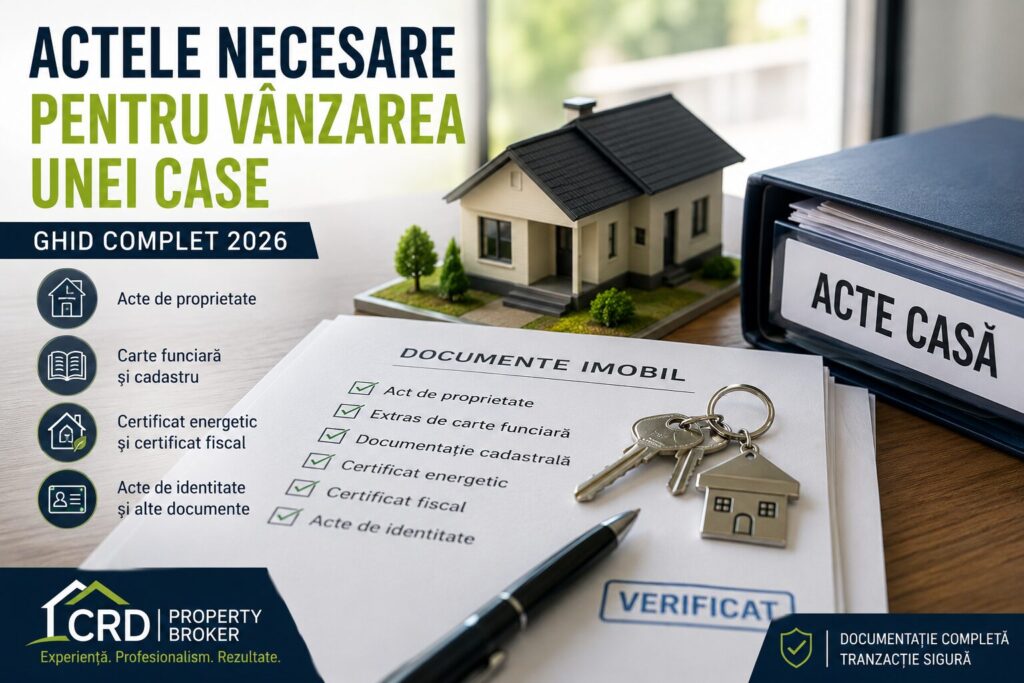
Selling a house requires more complex documentation than selling an apartment, as the transaction includes both the building and the land. In order for the process to proceed without delays, the owner must prepare in advance the property deeds, cadastral documents, tax certificate, energy certificate and, in certain situations, the documents regarding the construction of the building.
A house with incomplete, outdated or uncorrelated documents can cause delays at the notary, problems with the buyer's credit, or even the transaction being blocked. Therefore, checking the documents before promoting the property is an essential step.
In this guide, we explain, in the owners' understanding, what documents are required to sell a house in Romania and what checks should be made before signing the sales contract.
1. The deed of ownership of the house and land
The first document required is the deed of ownership. This shows how the owner acquired the house and the land surrounding it.
The ownership deed can be, depending on the situation:
- sale-purchase contract;
- donation contract;
- heir certificate;
- sharing agreement;
- final court decision;
- other authentic document by which the property was acquired.
It is important that the property deed be verified before promoting the house, especially if the property comes from an inheritance, donation, sharing, or if there are multiple co-owners.
2. Land Registry Extract
The Land Registry Extract is one of the most important documents in a real estate transaction. It confirms the data recorded in the land registry: the owner, the description of the property, the surfaces, any mortgages, encumbrances, prohibitions or other mentions.
Before signing the contract, the notary requests the land registry extract for authentication. He temporarily blocks the land registry for the transaction.
3. Cadastral documentation
The house must be correctly identified in the cadastral documents. In the case of a house, the documentation may include both the land and the existing building or buildings on the land.
In practice, the following must be checked:
- cadastral number;
- land surface;
- the footprint of the building;
- built-up area;
- the unfolded surface;
- the site plan;
- construction survey, where applicable.
If there are differences between the reality on the ground and the cadastral documents, it may be necessary to update the cadastre before the sale.
For official information regarding the cadastre, land registry and real estate advertising services, you can consult the website of the National Agency for Cadastre and Real Estate Advertising (ANCPI) .
4. Energy performance certificate
An energy performance certificate is required when selling a house. It is drawn up by a licensed energy auditor and shows the energy performance of the building.
The document contains information about:
- the energy class of the building;
- specific annual energy consumption;
- carbon dioxide emissions;
- recommendations for improving energy efficiency.
It is recommended that the energy certificate be obtained before signing the contract, not at the last minute.
The list of authorized energy auditors can be consulted on the website of the Ministry of Development .
5. Tax certificate and mandatory home insurance (PAD)
The tax certificate is obtained from the local tax office and confirms the tax obligations of the property. Typically, the notary requests this document before authenticating the sales contract.
If the owner has debts for building or land taxes, these must be paid before the tax certificate is issued or before the transaction is completed, as the case may be.
The home must also have a mandatory natural disaster insurance policy (PAD), in cases provided for by law. The existence of a valid PAD policy is a requirement that must be verified before the transaction is authenticated and may also be necessary in certain cadastral and real estate advertising procedures.
6. The deeds regarding the land related to the house
When selling a house, the land is of major importance. The buyer is not only purchasing the building, but also the land on which it is located.
Must be checked:
- the area of the land in the documents;
- the area registered in the land register;
- category of use;
- property boundaries;
- any easements or rights of way;
- access to public or private road.
In the case of lands with special situations, additional checks may be required regarding urban planning, neighborhoods, access and legal regime.
7. Building permit and construction acceptance
For houses built or extended under a building permit, documents confirming the legality of the construction may be required.
These may include:
- building permit;
- the reception report upon completion of the works;
- documents regarding subsequent extensions or modifications;
- other technical documents, depending on the situation of the property.
Problems frequently arise when the property has been extended, atticed, re-compartmented, or modified without all changes being reflected in the deeds.
8. Owners' IDs
When signing the contract, the identity documents of all owners are required. If the owner is married, the notary may also request a marriage certificate, depending on the legal status of the property.
Other documents may also be required, such as:
- marriage certificate;
- divorce certificate or divorce decree;
- death certificate, if applicable;
- heir certificate;
- authentic power of attorney, if the owner is represented by another person.
9. Selling a house with a mortgage
A mortgaged house can be sold, but the procedure involves the bank and the notary. In this case, it is necessary to obtain documents from the bank regarding the loan balance, repayment terms, and the cancellation of the mortgage.
Usually, the buyer, seller, bank, and notary establish how the loan is repaid and the mortgage is removed from the land register.
10. Common mistakes when preparing documents for selling a house
In practice, the most common problems arise when the deeds do not reflect the real situation of the property.
Common mistakes include:
- different surfaces between documents, cadastre and reality on the ground;
- unlisted buildings or annexes;
- lack of construction reception;
- extensions made without updating the documentation;
- unfinished successions;
- several co-owners who do not agree with the sale;
- unpaid tax debts;
- mortgage or prohibitions not clarified before negotiation.
11. Why it's good to check documents before promotion
Many homeowners start promoting their home before they have even checked the documents. This approach can lead to losing serious buyers, especially if they are buying on credit or if the notary identifies problems before signing.
A preliminary check of documents helps to:
- correct pricing;
- avoiding delays;
- increasing buyer confidence;
- negotiation preparation;
- faster transaction completion.
If you want to sell a house in Bucharest, it is useful to prepare the documents before publishing the ad and before the first viewings.
Conclusion
The documents required for selling a house must be carefully analyzed, as the transaction involves both the construction and the land. The property deed, land registry extract, cadastre, energy certificate, tax certificate, and construction documents must be clear and up-to-date.
Complete documentation reduces the risk of delays and gives the buyer confidence. Before promoting a home, checking the documents is one of the most important steps for a safe and efficient sale.
For more useful information, you can also consult the CRD Property Broker guides on the documents required for selling an apartment and the documents required for selling a plot of land .
Frequently asked questions about the documents required for selling a house
What documents are required to sell a house?
To sell a house, the following documents are mainly required: the title deed, land registry extract, cadastral documentation, energy performance certificate, tax certificate and the owners' identity documents. Depending on the situation, the notary may also request other documents.
Is the energy performance certificate mandatory?
Yes. In most real estate transactions, the energy performance certificate is mandatory and must be presented to the buyer before signing the sales contract.
Can a house be sold if it is mortgaged?
Yes. A mortgaged house can be sold, but the transaction is carried out together with the financing bank and the notary public, who establish the procedure for repaying the loan and canceling the mortgage.
What happens if the surface in the documents does not correspond to reality?
If there are differences between the cadastral documentation and the situation on the ground, they must be analyzed and, if necessary, remedied before the transaction is completed. In some cases, it is necessary to update the cadastre and land register.
Is a building permit required when selling a house?
For many houses, especially those built or extended under a permit, the buyer or notary may request the building permit and the acceptance report upon completion of the work to verify the legality of the construction.
Can I sell the house if it is inherited?
Yes, but ownership must be proven by the inheritance certificate or other legal documents. If the succession is not finalized, it must be resolved before the sale contract is concluded.
How long are the documents required for the sale valid?
Not all documents have the same validity period. For example, the land registry extract for authentication and the tax certificate have a limited validity, which is why they are usually obtained before signing the contract.
Is it recommended to check documents before publishing the ad?
Yes. Checking the documents before promoting the house allows the identification of any legal or cadastral issues and reduces the risk of delaying or blocking the transaction after finding a buyer.