
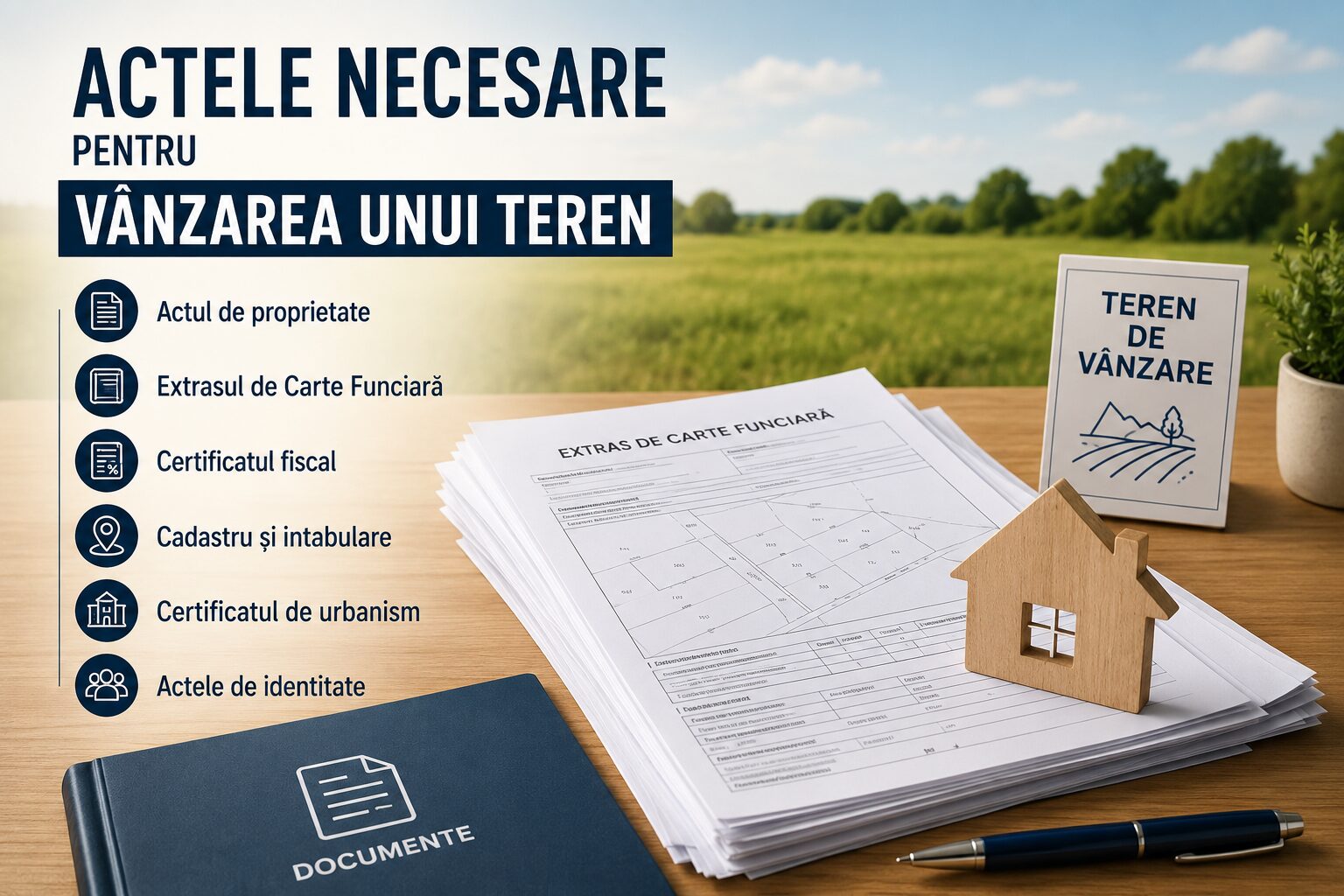
Selling a plot of land may seem simpler than selling an apartment or a house, but the documents must be carefully checked before signing the contract at the notary. Depending on the type of land — urban, extra-urban, agricultural, buildable or with encumbrances — additional documents may be required.
Proper preparation of the documents helps avoid delays, renegotiations, and issues that may arise on the day of signing. If you have land for sale in Bucharest, Ilfov, or nearby areas, you can request support through the Submit your listing page or contact us directly through the CRD Property Broker contact page.
Table of Contents
- Proof of ownership
- Cadastral survey and land registration
- Land Registry Extract for authentication
- Tax certificate
- Urban planning certificate
- Extra-urban agricultural land and the right of preemption
- Identity documents and civil status documents
- Notarial power of attorney
- Special situations
- Recommendation before selling
1. Proof of ownership
The proof of ownership is the main document that proves the seller's right to the land. Depending on how the land was acquired, it can be:
- sale-purchase contract;
- donation contract;
- exchange contract;
- certificate of inheritance;
- final court decision;
- property title;
- division deed;
- other authentic document through which the ownership right was acquired.
It is recommended that the seller also keep other documents from the land's history, especially if the property comes from inheritance, division, restitution of ownership rights, or other older situations.
2. Cadastral survey and land registration
In order to be sold, the land must be cadastrally identified and registered in the Land Registry. This means the land must have a cadastral number and be registered under the name of the current owner.
The cadastral documentation contains technical data about the land, such as the surface area, location, boundaries, and land use category. If there are differences between the documents, measurements, or the actual situation on the ground, these must be clarified before signing the sale contract.
For general information about cadastral and Land Registry services, you can consult the official ANCPI portal.
3. Land Registry Extract for authentication
The Land Registry Extract for authentication shows the current legal status of the land. It contains information about the owner, surface area, land use category, any mortgages, restrictions, easements, or other registered encumbrances.
Usually, the Land Registry Extract for authentication is requested directly by the public notary, not by the owner. It is used to authenticate the notarial deed of sale.
It is different from the Land Registry Extract for information, which can be requested for a preliminary check of the legal status of the land.
4. Tax certificate
The tax certificate is issued by the Local Taxes and Fees Department within the city hall. It confirms that the land is registered for tax purposes and that the local tax obligations related to the property have been paid.
The tax certificate must contain the correct owner details, the address or identification of the land, and a statement regarding the status of local tax obligations.
This document must be valid on the date the sale contract is signed.
5. Urban planning certificate
The urban planning certificate is not mandatory in all land sales, but it can be very important, especially when the land is purchased for construction purposes.
The urban planning certificate can be used to check information such as:
- the legal status of the land;
- the economic status;
- the technical status;
- the possibility of building;
- applicable urban planning indicators;
- restrictions or special conditions.
In practice, a buyer interested in buildable land may request this document before making the final purchase decision.
6. Selling extra-urban agricultural land
If the land is agricultural and located outside the urban area, the sale may involve a special procedure, regulated by Law no. 17/2014. In these cases, the right of preemption of certain categories of persons or institutions must be respected.
The procedure may involve posting the sale offer at the city hall, complying with legal deadlines, and obtaining the documents necessary to finalize the sale.
The right of preemption
The right of preemption gives certain persons or entities priority to purchase the land, under the conditions set by law. Depending on the situation, potential preemptors may include co-owners, tenants, neighboring landowners, or other categories provided by law.
Why this aspect must be verified before promoting the land
An extra-urban agricultural land should not be treated the same as ordinary urban land. If the legal procedure is not followed, the sale may be delayed or even blocked.
For such land, it is recommended that the owner discuss the matter in advance with the notary and, if necessary, with the relevant local authority.
7. Identity documents and civil status documents
All owners participating in the sale must present valid identity documents.
Depending on the seller's personal situation, the notary may also request:
- marriage certificate;
- divorce certificate or final divorce ruling;
- death certificate of the spouse;
- certificate of inheritance;
- documents regarding the marital property regime;
- other civil status documents.
8. Notarial power of attorney, if the owner cannot be present
If one of the owners cannot be present at the signing of the contract, they can be represented through an authentic notarial power of attorney.
The power of attorney must be valid and clearly state the agent's right to sell the land, sign the necessary documents, and collect the price, if that is the owner's intention.
9. Special situations that may require additional documents
Not all land is sold the same way. Depending on the legal and technical situation, the notary or the buyer may request additional documents.
Such situations may arise when:
- the land is mortgaged;
- there are co-owners;
- the land comes from inheritance;
- there is a right-of-way easement;
- the land is under litigation;
- the land is leased;
- there have been recent subdivisions or mergers;
- the land use category needs clarification;
- the address or cadastral identification does not match the old documents.
10. Recommendation before selling a plot of land
Before promoting the land, it is recommended to check the proof of ownership, the cadastral survey, the land registration, the tax certificate, and any encumbrances registered in the Land Registry.
For buildable urban land, it is useful to check the urban planning regulations. For extra-urban agricultural land, the special procedure regarding the right of preemption must be verified.
A check made in advance can prevent delays, renegotiations, and blockages in the transaction.
If you have land for sale, you can send the details through the Submit your listing page or request a direct discussion with CRD Property Broker.
You can also check out our article about the documents needed to sell an apartment, to understand the differences between the required documents depending on the type of property.
Frequently Asked Questions about the documents required for selling land
Can I sell land without a cadastral survey and land registration?
Normally, no. The land must be cadastrally identified and registered in the Land Registry in order to be sold through a notarial contract.
Who requests the Land Registry extract for authentication?
As a rule, the Land Registry extract for authentication is requested directly by the public notary, not by the owner.
Is the urban planning certificate mandatory when selling land?
It is not mandatory in all cases, but it is very useful when the land is purchased for construction or when the buyer wants to check the urban planning regulations.
What documents are required for selling extravilan agricultural land?
In addition to the usual documents, selling extravilan agricultural land may require compliance with the pre-emption right procedure, according to Law No. 17/2014.
Can I sell mortgaged land?
Yes, but the transaction must be prepared together with the notary and, if applicable, with the creditor. Documents regarding the creditor's consent, the outstanding balance, and the removal of the mortgage may be required.
What happens if the land has multiple co-owners?
All co-owners must participate in the sale or be represented by a notarial power of attorney, within the limits established by the power of attorney.